
Advocate Access
Get In Touch


News
January 2026 Advocate Spotlight: Madge Hollinger and Terri D’Agostino
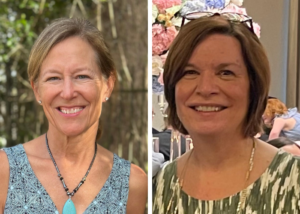 We invite you to meet Madge Hollinger and Terri D’Agostino, nominated by Advocacy Specialist Nicole Williams. Madge joined Child Advocates as a volunteer in 2016, and Terri became an Advocate in 2025. The two Advocates are working together on a child welfare case. Madge has worked on six child welfare cases, including two that each lasted more than three years. Terri has been an Advocate on two cases since she joined Child Advocates less than one year ago!
“Madge and Terri are an incredible team,” Nicole said. “Their documentation is always thorough, and they bring a positive presence to both the kids and their families. Madge is committed to helping the family in any way she can and is working hard to build a relationship with the mom on her current case. Terri’s background in education has been invaluable—she’s able to help explain IEPs to parents and provide the support they need to navigate the process. Together, these Advocates are making a tremendous impact!”
We asked Madge and Terri to share their experiences as Advocates for children in foster care.
Is there anything unique about your background that contributes to your approach to advocacy?
Madge: I grew up with five siblings. The six of us were born to parents from the ages of 19 to 29. There was plenty of trauma in the home; however, both parents did their best to teach us to love others and help others. I did a lot of work in Zambia, Africa, with vulnerable children and wanted to do something for vulnerable children closer to home. I love children and want to help them to have the best opportunity they can.
Terri: I am an adoptive parent of four children—three children formally and one child informally. They are grown now with my baby being 32 years old. My youngest came to me as a four-year-old child in foster care, and that was 29 years ago! Professionally, I’ve spent most of my career in special education, so I’m quite familiar with those systems and processes as well.
How did you become interested in volunteering as an Advocate?
Terri: Being an Advocate has been on my radar for a while now, but the real impetus was visiting with some members of my church who are current CASA volunteers. They encouraged me to look into it. I’m very new to this—I just got trained this past June.
Madge: I have a sister that was an Advocate in North Texas. As she shared her experiences with me, I decided that becoming an Advocate would be a great opportunity to help children in Montgomery County.
Did you have any reservations about volunteering? If so, how did you overcome them?
Madge: The biggest reservation that I had was the fear of doing something or saying something wrong. I just began and put one foot in front of the other and sought help from my Advocacy Specialist when I was unsure of something.
Terri: Of course I had reservations . . . will I know what to do? Can I truly be a support to families in crisis, dealing with trauma? Can I make the paradigm shift from my “mama lens” to a more objective way of looking at things? And finally, with aging parents and grandchildren in my life plus a part-time job, do I have the time? When I was offered the opportunity to partner with a more experienced Advocate on this current case, it made all the difference.
Explain in your own words the work you do as an Advocate.
Madge: I seek to get to know everyone involved in the case. I determine if there is anything that I can do to help the parents understand the gravity of the situation and how best they can work to get their children back in their home. I work to help the children know that they are loved by many people. For a few of my cases, I was the only person that stayed with the case for the whole extent of it. The children, the foster parents, the parents knew me and knew that I was there to help. I also got to know teachers, therapists, etc. with some cases. The more people that I knew and that knew me, the better we all worked as a team for the best interest of the child.
Terri: Honestly, I’m following Madge’s lead a lot on this one. Together or separately, we have visited the family in their home multiple times, appeared in court, and eaten lunch with our little friend at his school. She was also able to attend his ARD meeting. I see the difference it’s making in the relationships being developed with the children and their village.
Share about your experience working with a co-Advocate.
Madge: Lately, I have traveled quite a bit since my husband retired. It is nice to have a co-Advocate so that things are handled in a timely manner. This is the second case that I am working with a co-Advocate on, and it is especially nice to have Terri’s expertise with the school system since we have a school-aged child. On my last case, it was nice to have a co-Advocate that I could discuss the case with and bounce ideas off and even someone with whom to ride the hour to visit the child in the foster home.
Terri: I’m very thankful to be working with Madge as she brings a wealth of experience to the table. The primary advantage is the obvious one—when you share the load, it makes everything easier.
Can you explain how you work together as a team?
Madge: We text if we need to do something specific and decide who will do it. We are on a group text with the caseworker, and it is nice to have multiple ideas presented. Because of my travel schedule, currently, Terri and I are taking turns doing visits for the next few months. That is very helpful.
Terri: We communicate primarily through text, plus the occasional phone call or Zoom meeting. We met for coffee once, which was a lot of fun!
What would you like the community to know about children who are in foster care?
Madge: Every child has potential, and having one caring adult truly can make a difference in the life of a child. Helping that child find multiple caring adults makes even more of a difference!
Terri: There is such a strong need to support children and families in crisis and consequently to support the caseworkers, therapists, attorneys, and judges who are doing their very best to do what’s right for children.
What have you learned about children in crisis through your advocacy work?
Terri: It’s made me see some of the things my children have experienced through a new lens. And I’ve learned that children don’t have to be in foster care to have experienced trauma and for that trauma to impact them in various ways throughout their lives.
Do you have a favorite memory or moment of advocacy?
Madge: One of my cases began with two young people, a brother and sister with different dads, who entered the child welfare system at five and six years old. After a few years in foster care, they were adopted by incredible people. Participating in that adoption was amazing, and seeing their lives now—five years later—is an incredible blessing. They are both thriving in middle and high school.
Terri: The most rewarding thing for me so far on this journey was to be present at the adoption of my first sibling group. What was truly amazing was seeing the courtroom full of people there to support this family. The judge seemed surprised as well. She said, “Are all these people here for this adoption?” And then she asked everyone to come stand with the family while the formalities were completed.
Anything else you want to share about Child Advocates?
Terri: It is my personal belief that we all have an obligation to do whatever we can to make a small difference in our little corner of the world. It is my hope that being an Advocate might be that for me.