
Advocate Access
Get In Touch


News
May 2026 Advocate Spotlight: Pam Byrne
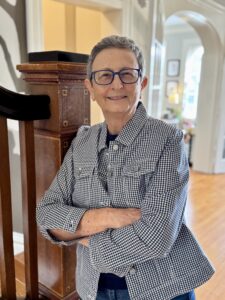 We invite you to meet Pam Byrne, the 2026 Women of Distinction Honoree for Child Advocates of Montgomery County. Pam joined Child Advocates as a volunteer in 2018, and she has served on 17 child welfare cases and 4 Justice-Involved Youth (JIY) cases. Her Advocacy Specialist, Hiroko Schyvincht, said that Pam is always looking for meaningful ways to support a child’s growth and confidence.
“Pam is a steadfast and compassionate Advocate,” Hiroko said. “She is currently advocating for a teen girl, and she approaches every interaction with honesty and courage. Pam doesn’t shy away from difficult conversations, especially when they are in the child’s best interest. Her guidance is both practical and empowering, helping the teen set achievable goals as she prepares for adulthood.”
We asked Pam to share about her experiences as an Advocate for youth in the child welfare and juvenile justice systems.
Tell us about your background. Is there anything about your life experience that shapes your approach to advocacy?
I grew up in Houston in a home that had domestic violence. My parents divorced when I was 10. It was the best thing for us, but it put a stigma on my family. It was the fifties, and there were friends who couldn’t play at my house because I was from a divorced family. My mom was great; she was a lion for her cubs. She showed me how to persevere and be strong. I’ve taught for more than 52 years. Now I teach future teachers at the University of Houston.
What sparked your interest in volunteering as an Advocate?
I originally wanted to volunteer at a women’s shelter. But something just made me think “it’s the children who are more vulnerable.” I researched everything I could find on how to help children. I was called for this work. I got up one day and applied. I love the kids on my cases. I want them to have the same experiences and opportunities other kids have, and they don’t. I feel bad about that. I want a little bit of normalcy for these kids.
Did you have any initial hesitations about volunteering? If so, how did you overcome them?
No hesitations. I was so eager to start training. The training was informative and eye-opening. I just like learning. That’s why I attend so many of the classes Child Advocates offers. Our initial training prepares us to an extent, but until you get on a case, you don’t know what you’re going to see and learn. The minute you start getting cases, your training starts to make sense. You realize what you don’t know, and the help from the staff has been crucial.
Explain in your own words the role of an Advocate and why this work is so important for a child in care.
Our role is to be the eyes and ears. We get to know every single entity involved in the case—parents, lawyers, caseworkers, placement, therapists, doctors, and teachers. We get the total picture to present in court. We also listen to what a child says even when they’re not really saying it. They were brought into foster care for a reason, and we help fill those gaps and help them feel more secure, ensuring their emotional and physical needs are met.
What has surprised you most about your work as an Advocate?
How much I have grown to love each of these kids. I thought I could stay neutral, but you can’t.
What has been the most challenging and the most rewarding part of advocacy work?
We’re required to see the kids at least once a month, but I feel like I need to see them more than that to maintain the connection. Visiting them more than once a month can be hard sometimes with my schedule. Also challenging is how closed up some of these kids can be. Sometimes, they don’t tell me how they’re feeling. I know we’re connected, but they’re guarded. Sometimes I’m surprised by how much anger and rejection these kids have experienced. Parents rejecting them for various reasons, or neglect. They have had a lot of placements, and they keep getting rejected from placements. That rejection creates a lot of anger.
Most rewarding is when a kid does say “I love you” for the first time, or leans in for a hug when you say goodbye.
What do you wish the community better understood about children in crisis?
I wish the community understood why we’re here and all the things we do. They see things and think “oh, that child has been abused or neglected,” but they don’t see the child. They don’t see the hurt, all the things the child has gone through, all the places they’ve had to lay their head. One of the boys on my cases is in his sixth RTC [residential treatment center], and he’s only 11. This little boy and his sister were placed in a foster-to-adopt home. The family adopted her but decided not to adopt him. I make sure he has a bike, has a winter coat, has the right shoes. I got him a Nintendo Switch for Christmas because all the other kids at his school had one. I didn’t want him to be left out.
Through volunteering, what have you learned about children and families in crisis?
Every family is different. Every situation is different. Every child, no matter what they look like on paper, is unique in their experience of trauma. You can have two kids removed from their parents for the same reason, but the trauma in each child is different and their behaviors can be different.
Do you have a favorite moment of advocacy?
Yes, it is the first time the 11-year-old I’m advocating for leaned in for a hug. Then he said he loved me. I’ve been his Advocate for four years.
Anything else you want to share about Child Advocates?
I appreciate so many training opportunities to learn more. I just love being part of this organization. I love coming to the house and seeing all the staff.