
Advocate Access
Get In Touch


News
December 2025 Advocate Spotlight: Stephanie Bowie and Leszlie Nedelka
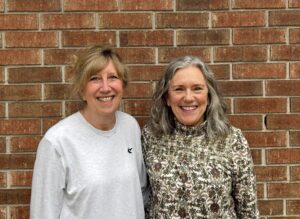 We invite you to meet Stephanie Bowie and Leszlie Nedelka, nominated by Lead Advocacy Specialist Sol O’Leary. Leszlie joined Child Advocates as a volunteer in 2011, and Stephanie became an Advocate in 2023. Friends for more than 20 years, Leszlie and Stephanie work together on child welfare and educational advocacy cases, making a dynamic team. They have served on two child welfare and one educational cases together. Prior to working with Stephanie, Leszlie served on 16 additional cases.
“Leszlie and Stephanie bring endless compassion and care to every child and family they work with,” Sol said. “Their friendship and professionalism set them apart as a truly extraordinary team. Their efforts have made such a difference in every case.”
We asked Leszlie and Stephanie to share their experiences as Advocates for children in foster care and Student Success Advocates.
Is there anything unique about your background that contributes to your approach to advocacy?
Stephanie: I was raised by my dad because my mom died when I was very young. Being raised by a single parent makes you realize that kids being raised by one parent, but even in some cases with both parents, always need support. My mom was a big volunteer; it’s just something I’ve always done. I feel like you’re supposed to be part of the community.
How did you become interested in volunteering as an Advocate?
Leszlie: I’d always heard about Child Advocates, but I had a neighbor across the street from me, Patty Spahr, who was a CASA Advocate in Montgomery County forever. I got to know her and that’s what made me sign up to volunteer.
Stephanie: Leszlie and I have been friends for over 20 years, and I knew of her work with Child Advocates and I knew Patty. I always said, “When I retire, I’ll be a CASA Advocate.” I retired, and it took me a year or two, but I did it. I always wanted to do it, seeing what Leszlie was doing. Children didn’t ask to be in the situation they’re in, so if we can amplify their voice, that’s so important.
Did you have any reservations about volunteering? If so, how did you overcome them?
Leszlie: I didn’t have any reservations about volunteering. At first, I had reservations about the ages of the children in the cases I took. I didn’t take a case with a teenager for a long time.
Stephanie: No. Sometimes you get into a case, and even though you’re given the background, you never really know what all the history beforehand. Like the case we have now, we didn’t realize just how complicated it all was. Every case is so unique. But you do learn from one case and how you can apply it to another case.
Explain in your own words the work you do as an Advocate.
Leszlie: When children are removed from their homes, the judge appoints us to be the constant in that child’s life throughout the case, which should be about a year, but that’s not always the case. We’re responsible for seeing them every month, checking in with teachers and doctors, and just being there for the child because we do make recommendations for what is best for them.
Share about your experience working with a co-Advocate.
Leszlie: I’ve been a co-Advocate on almost every case. I love working with someone. You have someone to bounce things off of or you get a different thought process. The nice part for me is that you have someone to share ideas with.
Stephanie: Sometimes, the way I see it and the way Leszlie sees it are different—neither one of us is right or wrong, we just have different perspectives. It’s a great way to bounce ideas off each other and to ask questions. It’s another set of eyes and ears, and both of us know the case.
What has been the most difficult aspect of volunteering as an Advocate? Most rewarding?
Leszlie: The most rewarding is getting to see a child placed back with a loving family member.
Stephanie: I’d agree. The hardest is when there is no one in the family who can take care of the children in a case. That’s the sad part—when a child doesn’t have loved ones who can take them. I’m so thankful for the cases that worked out with the children reunited with their families.
What would you like the community to know about children who are in foster care?
Stephanie: First, there’s not enough foster families. People don’t understand when a child is in foster care, or CPS conservatorship, just what’s all involved. We need to continue to educate people about the child welfare system and how they can support children in care and their families.
Leszlie: I always tell people that Texas gives a parent every opportunity and resource to try to make changes so they can provide a safe home for their children. People are usually very surprised by how many resources are available to support parents. People don’t understand how many times a child can move homes while in care or the reasons children can be removed from their parents’ home.
What have you learned about children in crisis through your advocacy work?
Leszlie: There’s trauma, and you may not even know the half of it for a while.
Stephanie: It gives you more empathy and compassion toward children who have gone through trauma. Not that you understand it, but it does give you more compassion. More people should be aware of how trauma can affect a child and their behaviors.
Do you have a favorite memory or moment of advocacy?
Stephanie: I remember when I met one dad for the first time at a parent-child visit, I had concerns that he would be unable to make the necessary changes to provide a safe home for his children. He tried, though, and he and his wife did everything asked of them. They completed TBRI® coaching, counseling, and all their services. Situations can change, and parents can make positive changes.
Leszlie: I’ve been advocating for one child for several years, and I think he knows who I am now. [Editor’s note: The child has autism and is nonspeaking.] That always makes me feel good that he might have an idea that I’m someone who cares about him. He’s 17 now, and I’ve been his Advocate since he was 11 or 12.