
Advocate Access
Get In Touch


News
Hope in Action: September 2025
Hope in Action is a series to highlight the aspects of our volunteer work. Advocacy for a child, whether in child welfare, juvenile justice, or truancy systems, covers several activities from court hearings to visits with a child to conversations with parents. Each month, we share a story of small (or big!) moments from one of our cases that exemplify what advocacy can mean to children and their families.
 Celebrating the Small Moments of Advocacy
In child advocacy, we often spotlight the big wins—adoptions finalized, families reunited, college acceptances, or the discovery of a relative who steps in to care for a child.
These moments are powerful, life-changing, and worthy of celebration. But just as important, and sometimes overlooked, are the quiet, consistent moments that happen month after month when an Advocate shows up for their visit with the child. These moments build trust, connection, and hope.
A Requirement that Builds Relationships
National, state, and local program standards require Advocates to meet monthly with each child they serve. These visits are more than a checkbox on a case. Each visit is an opportunity for the Advocate to show up, be present, and build a relationship with the child.
One interaction may not shift the course of a case, but they shape the experience of a child while in care. The monthly contact also helps the Advocate determine recommendations in the best interest of the child.
These visits are the foundation of advocacy.
Connection Through Consistency and Coloring
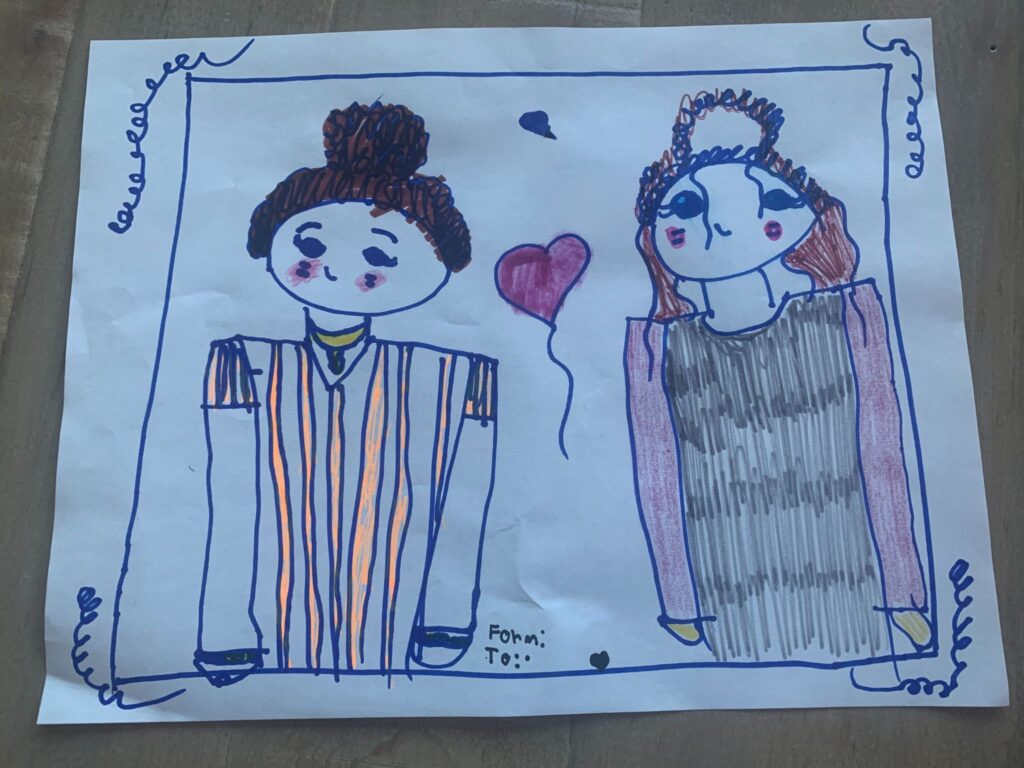
Our Advocate, Erin*, recently shared that she kept a drawing a child made for her at one of these visits, years after the case closed. The case involved four siblings, two girls in elementary school and two boys in high school, who had been removed from their mother’s home by Child Protective Services. Erin and a co-Advocate shared the case. She was the primary Advocate for the two girls. For one visit, she brought markers and a big pad of paper for the girls to color while they talked.
“Laney* drew a picture of the two of us together,” Erin said. “I have really curly hair, and she drew all these curls all over my head! She had drawn hearts everywhere, then she gave it to me and said ‘I made this for you!’ And I’ve kept it ever since.”
Erin said the girls connected with her from the beginning of the case, and they loved her visits each month.
“The minute I’d walk through the door, they’d give me big hugs,” Erin said. “They would get upset when it was time for me to leave. We had a rapport like no other.”
Reaching the Older Siblings
Though the two older boys had their own Advocate, they also appreciated Erin’s encouragement and efforts to get to know them.
“Typical boys! They’d say hello, then retreat to their rooms,” Erin said. “But they always ate the pizza I brought. They were always very appreciative any time I brought a treat or activity for them.”
At one visit, Erin and her co-Advocate mentioned to the oldest boy, Cole*, that he could access educational benefits for college since he would turn 18 while he was still in foster care.
“When he realized that college was a strong possibility, his eyes lit up,” she said. “When we told him that, he said ‘I’m going to college.’”
The promise of financial assistance for college motivated him throughout the rest of high school.
“The last time I went, Cole gave me a hug unprompted,” Erin said. “We didn’t know that it would be our last visit, but we knew the case was nearing the end.”
The Heartbeat of Advocacy
These small gestures—hugs, drawings, shared laughter—are the heartbeat of advocacy. They may not make headlines, but they make a difference. They remind children that someone sees them, cares for them, and shows up for them consistently. For Advocates, these connections are often the most meaningful part of their volunteer work.
So, we celebrate the small moments, too. Advocacy isn’t just about the big outcomes; it’s about the relationships built along the way.
*Names and identifying details have been changed to protect the privacy of those involved and to maintain case confidentiality.